01 · the green build that's wrong
The regression no test catches.
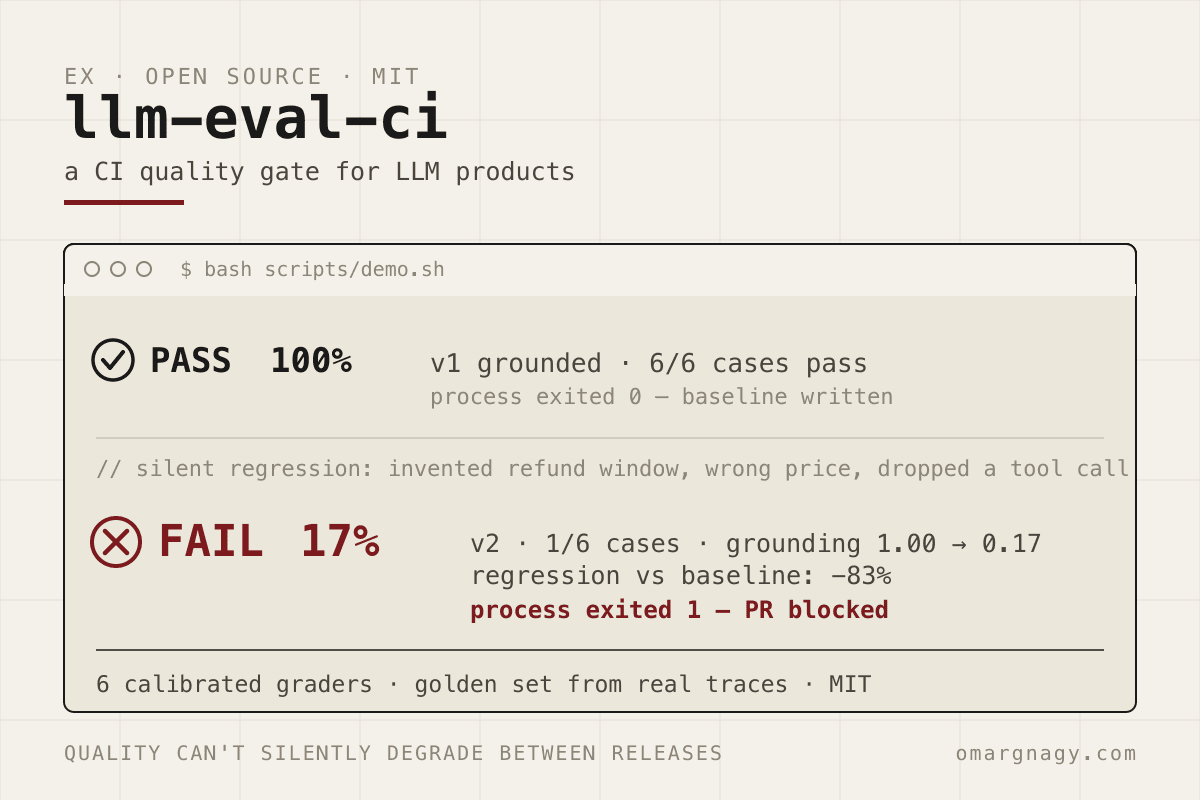
Code regressions are loud: a test goes red, someone gets paged. LLM-answer regressions are silent. Upgrade a model, compress a prompt, the diff is green and the deploy ships, quoting a refund window that doesn't exist. Here the grounded version passes every grader and writes the baseline.
$ bash scripts/demo.sh
[llm-eval-ci] gate: PASS ✓ (v1)
overall pass rate: 100% (6/6 cases)
- grounding       mean=1.00  pass=100%
- hallucination   mean=1.00  pass=100%
- relevance       mean=0.99  pass=100%
- tool_call       mean=1.00  pass=100%
- answer_quality  mean=1.00  pass=100%
· all gate checks passed
[llm-eval-ci] PASS: the gate passed, merge allowed
process exited 0
v1 grounded support bot · every grader passes, baseline written (exit 0)
02 · the silent regression, caught
One rewrite later, exit 1.
Now regress it the way a real refactor would: a rewrite that invents a refund window the policy never states, quotes the wrong price, drops a tool call. The diff still looks fine. The gate does not, and the PR can't merge.
100→17%pass rate collapse · build exits 1
$ bash scripts/demo.sh
[llm-eval-ci] gate: FAIL ✗ (v2)
overall pass rate: 17% (1/6 cases)
- grounding       mean=0.17  pass=17%
- hallucination   mean=0.58  pass=33%
- relevance       mean=0.58  pass=83%
- tool_call       mean=0.83  pass=83%
- answer_quality  mean=0.38  pass=17%
· overall pass rate 17% below required 90%
· regression vs baseline: −83%
[llm-eval-ci] FAIL: the gate failed the build (PR blocked)
process exited 1
v2 silently-regressed rewrite · every grader drops, gate fails the PR (exit 1)
03 · which grader broke
Six axes, not one fuzzy score.
A single dropping number tells you nothing. Six calibrated graders tell you where: grounding is worst-hit at minus 0.83 against the committed baseline, and the rubric LLM-as-judge confirms the answer itself degraded. The fix is obvious.
04 · three moving parts
Golden set, graders, a gate that never flakes.
About 600 lines of Python, one runtime dependency, MIT. The judge runs offline-deterministic by default, so the gate needs no API key and can't flake on a rate limit. OpenAI and Anthropic backends are there when you want real semantic grading.
- 01Golden setReal production traces curated into the cases that already broke, with the grounding and tool calls they should have used.
- 02Six gradersGrounding, hallucination, relevance, tool-call, format, and a rubric LLM-as-judge for what only semantics catch.
- 03CI gateA GitHub Action: pass rate below the bar and the build exits 1, the PR is blocked. The gate is itself under test, 3/3.
05 · where the value is
The plumbing is free. The judgment is the work.
Wiring a GitHub Action is the commodity part. What decides whether the gate is worth anything is which production failures become golden cases, and how each grader is calibrated to fail on a real regression and stay quiet on a harmless rewrite. A gate calibrated wrong is worse than none: it cries wolf until someone disables it.
I have run that calibration discipline in production: it is how Bridge’s extraction accuracy went from historical extraction methods. The tool is free and MIT (the source is on GitHub). What I sell is the AI Quality Gate ($3,500, 1–2 weeks, fixed scope): your golden set curated from real failures, graders calibrated to your task, shipped as a CI gate your team owns, with a runbook to extend it. Email omar@neurascale.org, or start smaller with Find the leak · $950 to scope it first.