01 · a map, not a dump
A context tree, not a context dump.
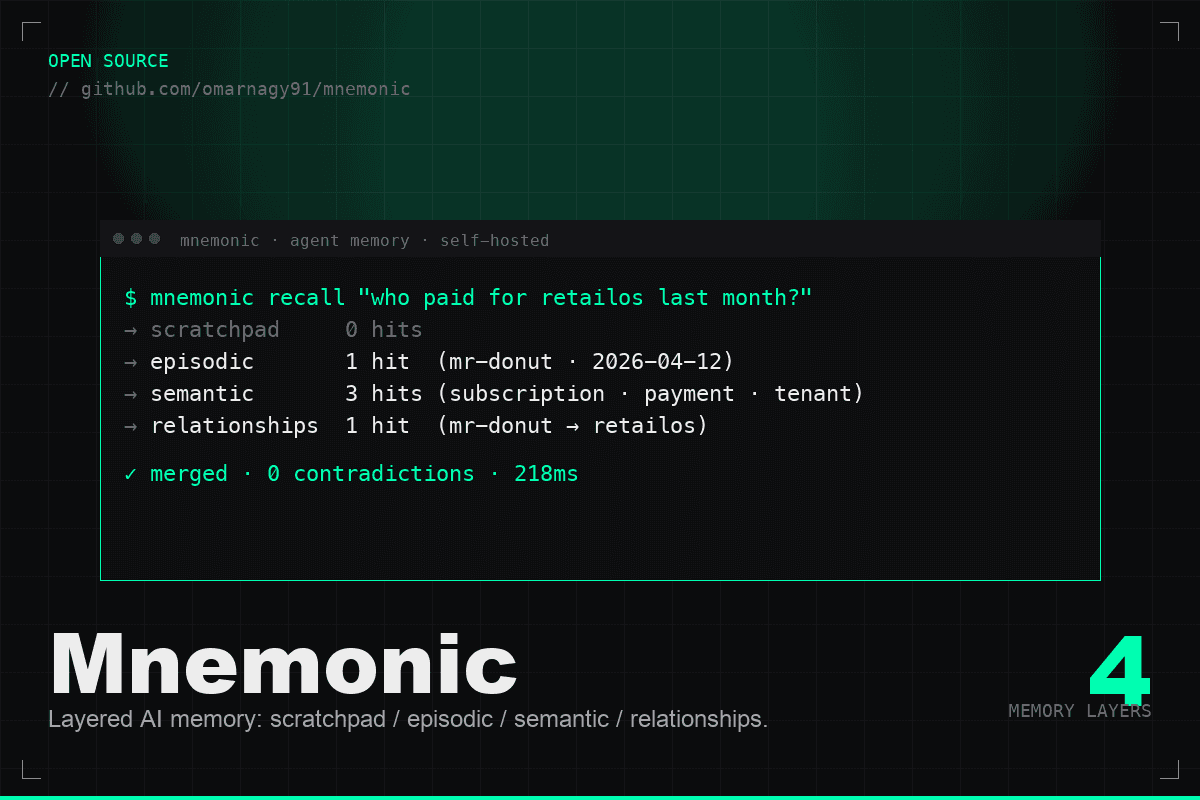
Most agent memory dumps everything into a vector store and hopes, or carries one history that truncates. Mnemonic serves a tiered tree: a compact map of what the agent knows, then detail only down the branch the question goes.
02 · the contradictory fact
Resolved, not duplicated.
The failure mode that bites real agents: vegetarian last week, chicken this week. mem0 reasons add, update, or delete underneath; an explicit detector is the opt-in stricter layer, being wired into /add as the first open issue.
“User is vegetarian.”
“User ordered chicken.”
03 · the architecture without the lease
The same architecture, on your own box.
The cloud memory APIs want your agents’ history on their server and bill around $20 a month per developer. Self-hosted on a small VPS with Qdrant, it runs roughly $2 a month and the history stays on yours.
~$2/moself-hosted vs $20+/mo cloud (estimate, not a billing screenshot)
Self-hosted is free: grab it from GitHub, point it at Qdrant, plug in your OpenAI key. Want it wired into a real agent fleet without a week of plumbing? Find the leak ($950, one week) picks the right memory shape for your domain and ships a working prototype.
04 · what the server does
The layers a raw library leaves to you.
mem0 owns the vector add/update/delete reasoning and Qdrant the storage. On top, Mnemonic adds the parts a raw library leaves to you, all self-hosted and licensed MIT.
- 01CategorizeEvery memory auto-sorted into one of seven categories with an importance score.
- 02ExtractPreferences and decisions pulled from a conversation, no “remember this” prompt.
- 03Retrieve + reflectSimilarity scored against recency and importance; /reflect synthesizes one answer, not a list.
- 04CompactNear the token limit, /compact saves the working context before old turns fall off.
- 05ExploreA graph, a timeline, per-category views: a memory layer you can see and debug.